
i thought peace meant being calm
The first thing they canceled was meditation.

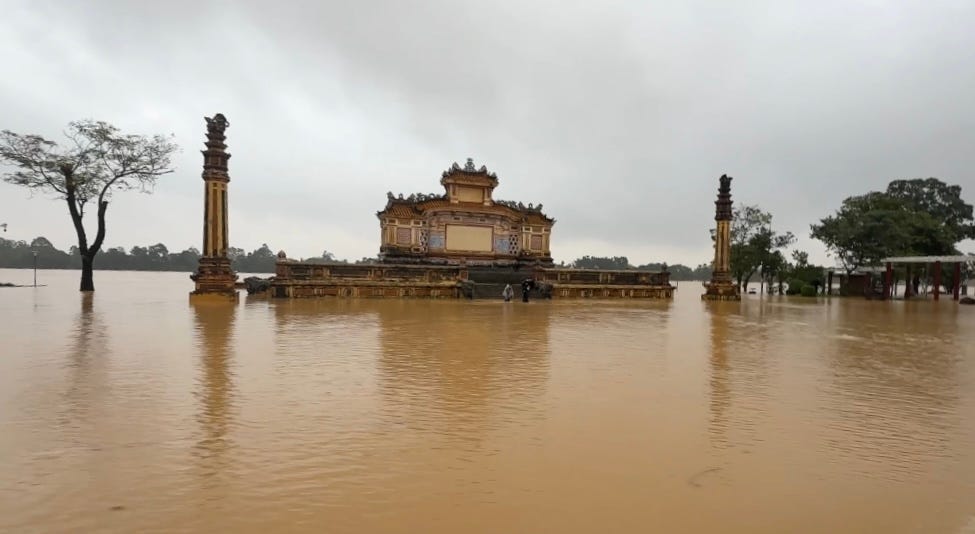
I remember standing in the dining hall, trying to understand what that meant. I had come to Huế looking for my roots. Instead, I was about to learn what peace looks like when the world refuses to be calm.
I went back to Việt Nam with the intention of visiting the temple Thich Nhat Hanh (Thay) ordained as a monk — Root Temple. I told myself it was a pilgrimage of respect. But underneath that was something harder to name. I have a longing for my roots. I left Việt Nam twenty years ago. For a long time, I did not think about what that meant. Only recently have I become aware of a quiet uprootedness inside me. It is strange to grieve something you did not know was missing.
The rain had no intention of stopping when we got to Hue. We came back during the rainiest season in decades. We waited in our homestay while the sky continued to pour itself onto earth, as if emptying years of stored grief. We only planned 2 days in Hue. After a few hours, we took our umbrellas and walked into the downpour.
Hue is an ancient city of kings and palaces. Vietnamese culture breathes slower here. More rooted. The temple looks like something from a Kungfu movie. Walls built of stones aged in green moss and humidity. Heavy curved arches with Chinese characters make walking through them feel like entering another realm. A realm of deep solemnity and reverence. Unlike the friendly, welcoming feeling I get when I attend Blue Cliff or Magnolia Grove monastery in the States.
We walked across the pond that Thay described in his books as the half-moon pond. He used to wash and cut jackfruit as a young monk here. The image made me smile. Here we are, standing in the same place — two points joined by space but separated by time. Two points that could never meet, yet are always together.
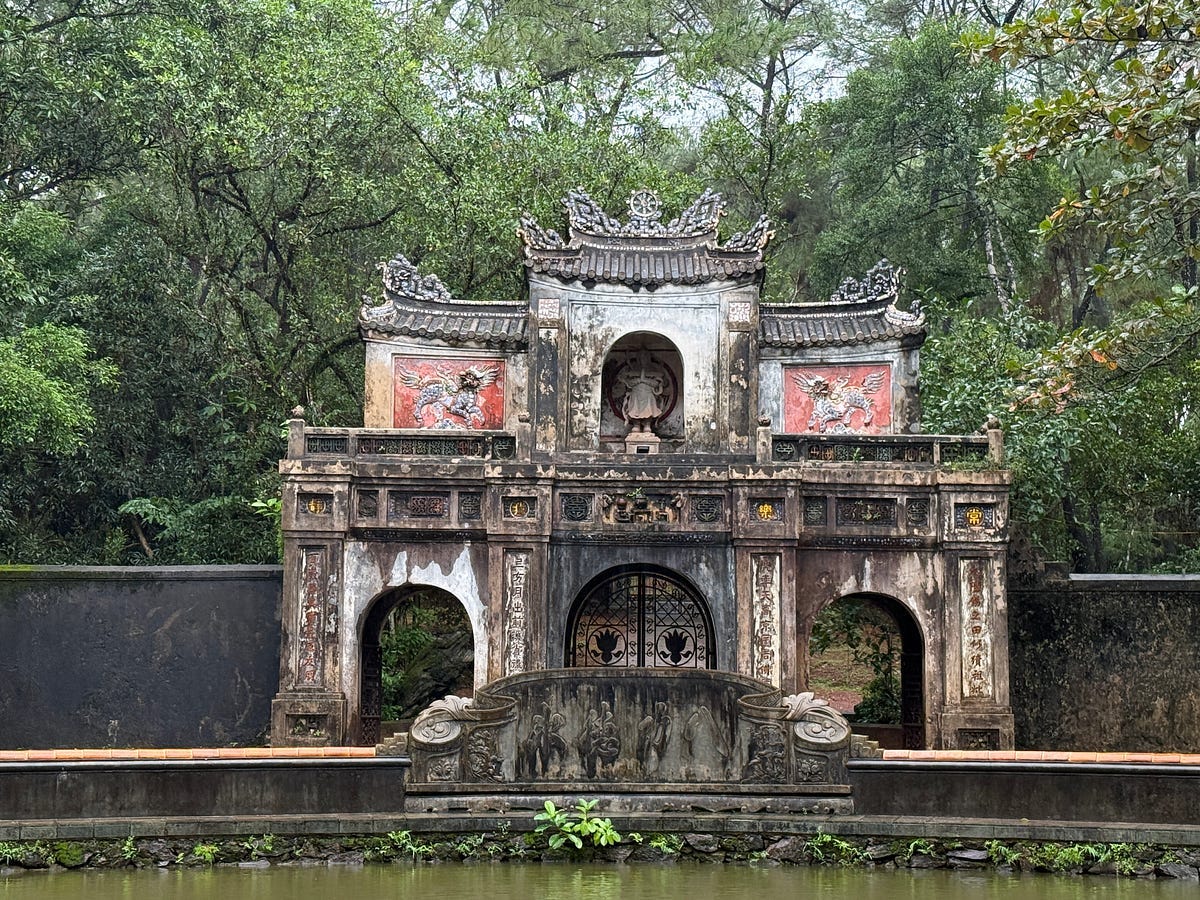
I wondered what it was like for him to leave such a place. To step away from moss-covered walls and ancient stillness to renew Buddhism for a fractured world. Perhaps once you hear the call of sky and earth, you no longer have the luxury of staying where it’s comfortable.
On my way out, I noticed a little nunnery next to the temple. If the temple was the main center, this looked like its parking lot. Overgrown bamboo arches covered a rusty metal gate. I remembered vaguely a sister at Blue Cliff telling me there was a nunnery near Root Temple that was practicing Plum Village tradition. Curious, we walked through the gate.
Immediately, something softened.
A sense of familiarity washed over me. It didn’t feel grand. It felt orderly and intimate. Like a peaceful co-living space rather than a place of worship. Two nuns stood under an awning behind a curtain of rain, slightly puzzled by our presence. I recognized the hesitation. Many Vietnamese people do not assume I am Vietnamese.
I introduced myself and explained that I had come to visit Thầy’s temple and wondered if I could meditate in the hall. I did not mention that I had stayed at Plum Village monasteries before, nor shared my devotion to his teaching. A sister smiled and led me upstairs anyway, reminding me to remove my shoes and wear dry flip-flops so my feet would not grow cold.
After meditation, she invited us to stay for dinner. They asked where we had come from and pressed a rack of bananas into Ray’s hands when we left. The next two mornings, we returned at 5:30 for meditation and stayed through the day. We had no idea what we were about to witness.
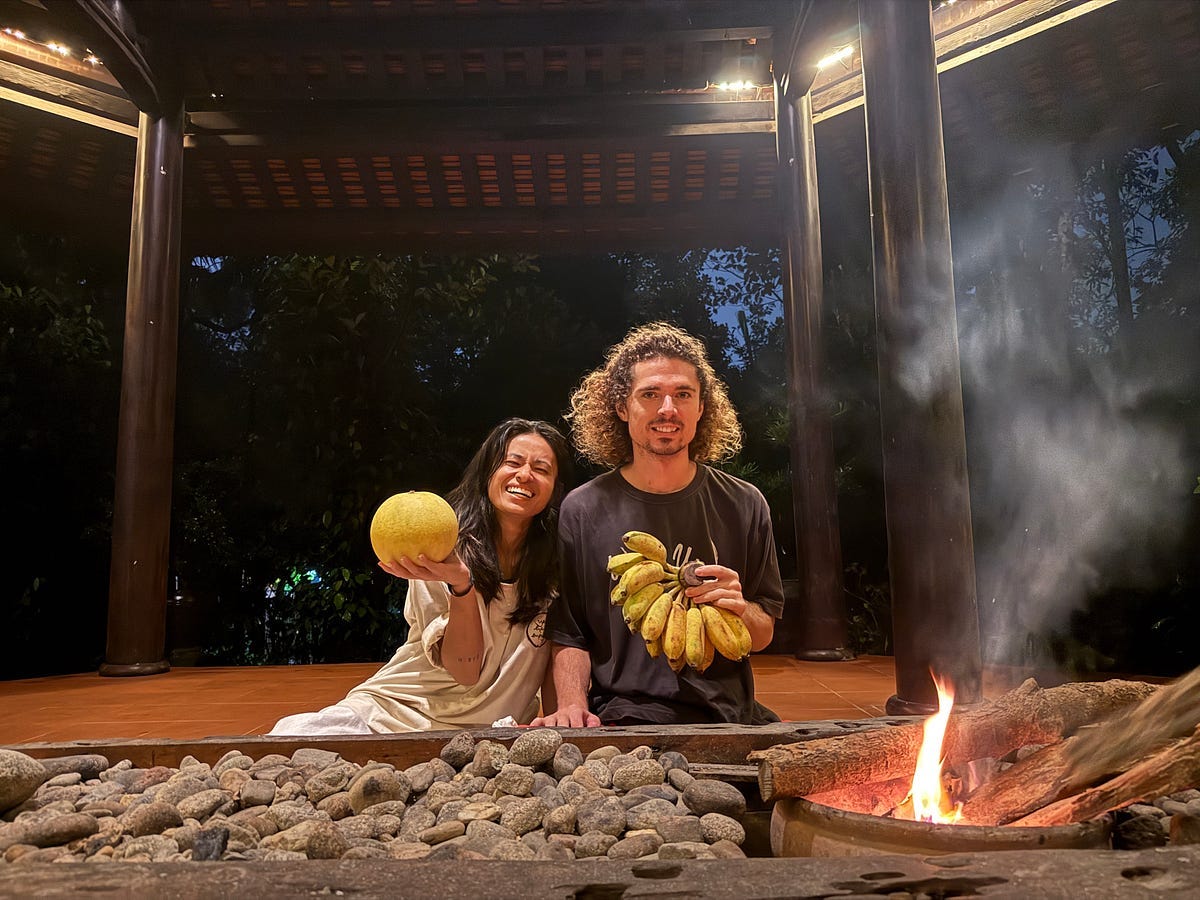
The schedule was like any monastery. Sitting meditation. Walking meditation. Working meditation. But there were no guests. Just us. In our free time, we sat in a hut and drank tea. Each day, a sister would carry wood across the grounds, build a fire for us, and sing songs she had written herself. When I asked her why, she said: “Because you are part of our sangha. You are family”.
For the first time in a long time, I did not feel like a guest on borrowed land. Sisters spoke in their mother tongue all day with joy. Their central accent sounded like songs flowing along a river. We treasured our native language and songs. We did not have to speak English to feel like we had earned our place. Although many sisters spoke English very well. Many of them were ordained at Plum Village in Thailand. And many study English to prepare for their trip overseas to serve the worldwide monasteries.
On the last morning, after meditation, I came into the dining hall to say goodbye, but something frantic was in the air.
Urgency.
A meeting has been called. The flood has taken a turn for the worse. The nearby hospital and residents were flooded last night. People were without access, power, and water. Meetings and arrangements with the gov’t have been made. For the next few days, all meditations and practices were to be canceled. All our effort would go into cooking and packing meals to deliver to people.
I delayed my flight.
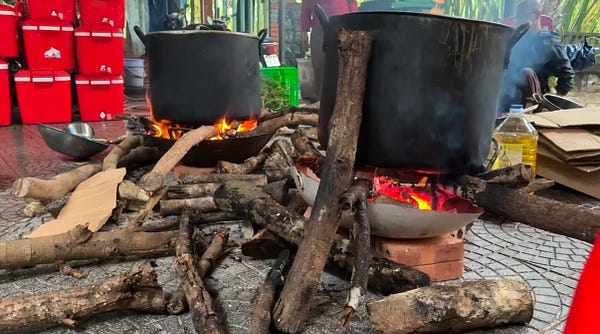
By afternoon, the monastery had also lost power. Giant pots of rice were placed over open fires. Smoke rose into the saturated air as wood cracked and sparks flew upward. A few of us joked that it felt like the night before New Year’s. Teams formed naturally — one tending flames, one washing vegetables, one chopping, one packing containers, and another going with the vans into the city.
Everyone worked quickly and with great diligence. A bystander from the outside might think we were stressed. But on the contrary. Every movement was synced to our breath. We breathed together and let our mindfulness lift the whole sangha.
After a few rounds of cooking and packing, I joined the group heading into the city. We traveled by motorcycle and stopped before the flooded area to get onto a large crane-mounted vehicle. The vehicle slowly waded through deep waters to bring us into the hospital. Crowds of people were waiting.
The poor monastics. No matter how calm and collected they were at the monastery, they could not keep it in front of the sea of suffering. They could not get people to form a line. Everyone was pushing, begging, and reaching for food.
For a brief moment, I felt the edge of panic rise in my chest. Then I heard a deep inhale by a sister next to me. Her hands trembled, but her breath did not. I anchored my breath to her rhythm and helped her hand out food.
When the sun tired, lanterns and flashlights were brought out. The burning coal turned the color of sunset in the dark. Smoke, rain, and swear mingled into something almost sacred in its intensity. We didn’t stop cooking until 8 pm. Just then, the power flickered back on. We cheered in innocent joy like children.
Hundreds of meals had been made. The hospital was fed. The mission continued for a week. I was not able to join them for the entire time.
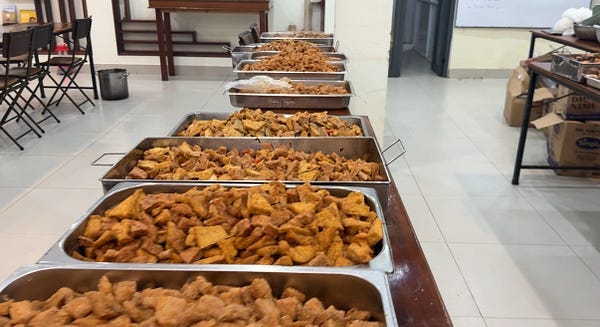
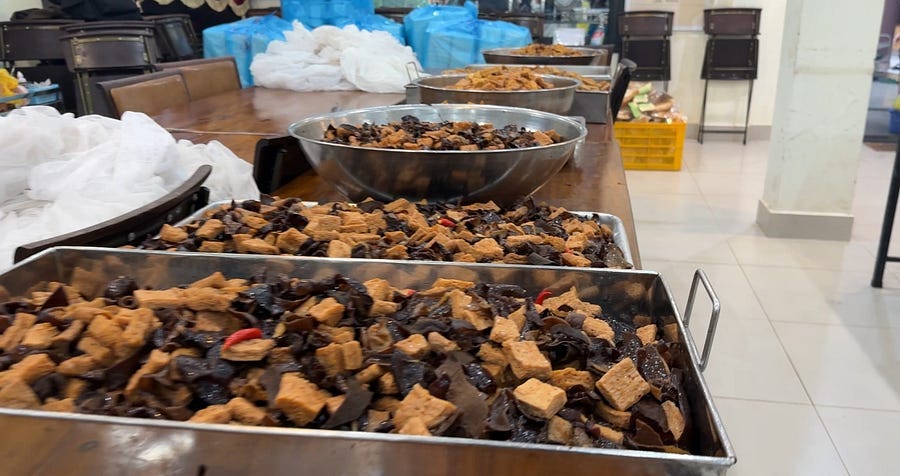
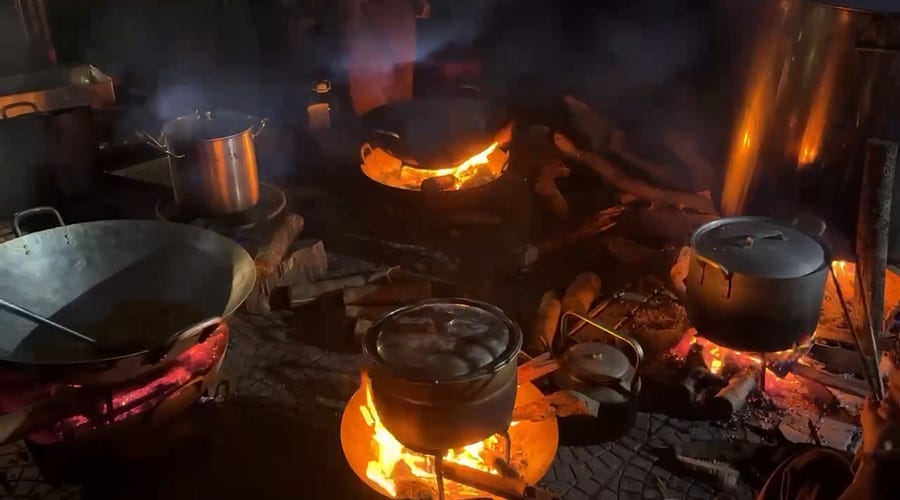
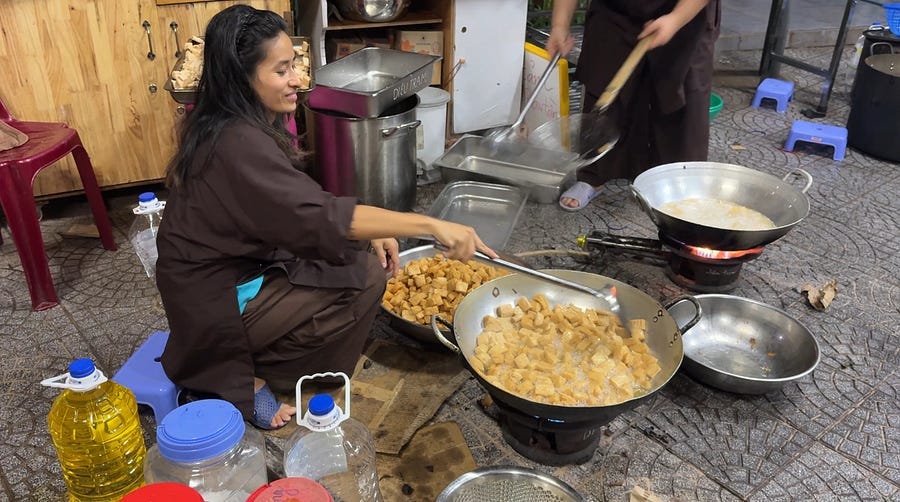
No temples around here had the resources or manpower to respond at this scale. Most only house a handful of monks. And they are not funded like Plum Village is through Thich Nhat Hanh’s foundation. The way 80+ nuns and monks rose to action overnight was not based on the theology of Buddhism or the idea of eternal life. This capacity could not arise from doctrine. It was the power of mindfulness practiced daily in small, unremarkable tasks.
I pick up my teacup, now filled with rainwater. The cup says ‘peaceful refuge’. It is my favorite tea cup. I got it in Hue. Lately, every time it rains, I can’t help but think about that city. How lucky was I to be there in that exact moment?
A community is slowly forming on Mango Mountain. This morning, we meditated with J&C and did yoga together. Then we had tea and talked about what we were excited to do today. The boys will build a shelf while Cherry and I start a garden of leafy greens.
But it is not important how many things we build or grow here. What’s important is that in everything we do, we learn to do it fully and mindfully.
Because peace is more than a fleeting feeling. It doesn’t arrive when chaos subsides. It is a practice rooted in every breath. It is the infrastructure that will uphold communities, keeping the collective nervous system intact under pressure.
If enough of us know how to wash our cups in peace, the world would surely transform.
subscribe to my youtube @meditatingmango for the upcoming video of this journey
LOVED THIS!